

SpeedSig Blog
Insights on Biomechanics, Performance & Sports Science
A versus B
Nobody asks early-career practitioners to defend a decision out loud. That gap is clinical reasoning, and mentoring that stops at watch me won't close it.
Means vs Modalities
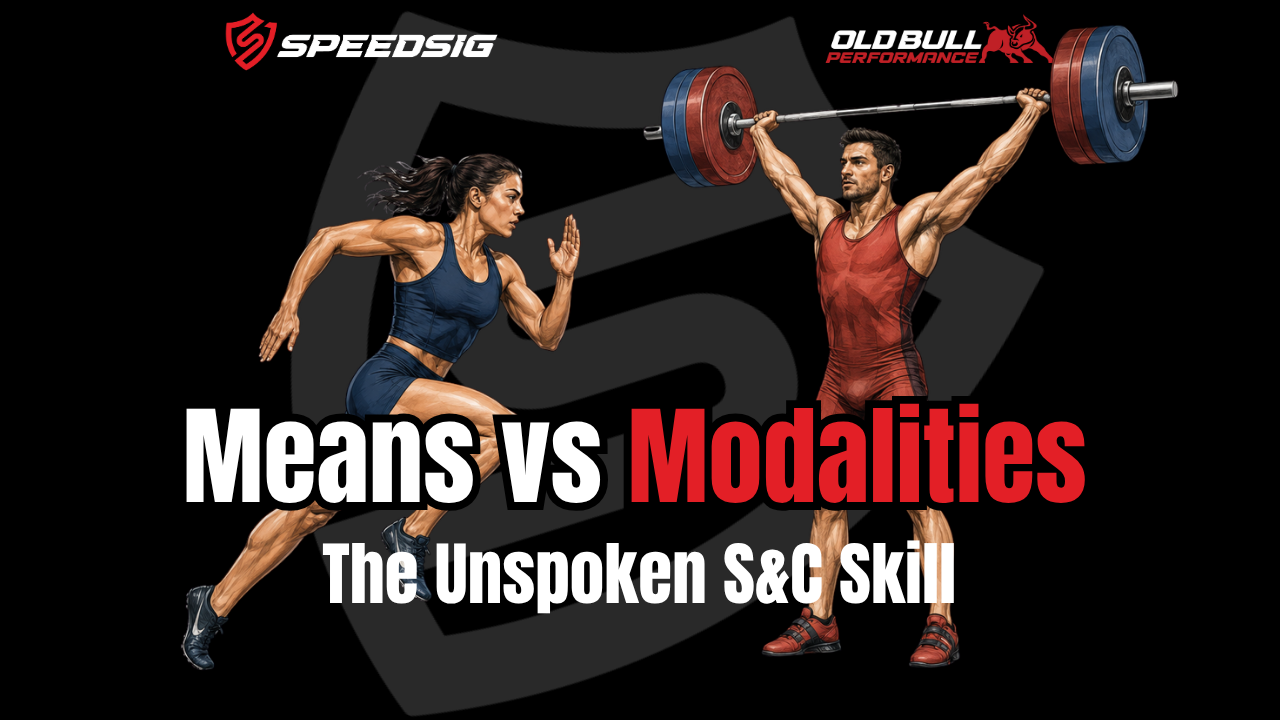
A dribble drill looks like running to anyone watching from the sideline. It isn’t conditioning. Done right, it’s repeated motor patterning aimed at pelvic and frontal-plane control and ground contact strength — a specific-strength activity wearing a running costume. Same story with a moderate effort on a curved treadmill for an athlete coming back from injury. Looks like some type of anaerobic conditioning work to anyone who doesn’t know what they’re looking at. It isn’t aerobic or anaerobic work at all — it’s mechanically demanding in a way that builds strength and resilience back into a joint that needs it. Same modality, completely different means, and if you can’t tell the difference, you’re coaching the wrong thing.



Running Is a System. Stop Treating It Like a Parts List.
This week I sat down with performance staff at a high-profile, silverware-winning UK football club to review a player with a recurring hamstring issue. What started as a single-athlete review turned into a broader conversation about how we use data in elite sport. A small vertical force asymmetry, visible in the running data, was quietly setting this athlete up for repeated injury — and the supporting evidence was already sitting in their hop test data. Nobody had connected the two. That's the problem SpeedSig exists to solve: not adding more data to an already crowded environment, but providing the interconnection layer that turns isolated numbers into a complete picture of the athlete.
If You Want the Job…Nail the Interview (Part 2)
Most young coaches panic when the interview invite lands but you don’t need experience you don’t have. You need a framework you can communicate. In Part 2 of this series, Jason Weber breaks down how to use your coaching framework to steer the conversation, answer technical questions with structure, calm the hiring panel’s fears, and stand out from dozens of similar CVs. Essential reading for anyone entering high-performance sport.

If You Want the Job…Build the Framework (PART I)
Young coaches keep asking how to break into pro sport. The truth? Degrees and buzzwords don’t separate you anymore — frameworks do. In Part 1, Jason Weber breaks down how to build a coaching framework that shows how you think, where you’ve learned from, and why it gets you hired. A must-read for anyone wanting to stand out in high-performance sport.

The Hamstring Challenge: Rethinking How We Approach Hamstring Injury
Discover why traditional hamstring rehab falls short and how measuring pelvic control and sprint mechanics can reduce reinjury risk. Learn how SpeedSig brings movement quality back into the conversation.

Lessons from Colin Powell: Leadership Wisdom for Sport & Life Part #1
Discover how Colin Powell’s leadership principles translate to sport and high-performance environments. Jason Weber shares key lessons on responsibility, trust, decision-making, and innovation that every coach and performance leader can apply.

The Evolution of SpeedSig 3.0
SpeedSig 3.0: From Data Platform to Decision-Making Companion for Coaches. SpeedSig 3.0 simplifies running biomechanics with clear visuals, colour-coded analytics, and faster insights — built by a coach, for coaches.

The Real Differentiator: What You Do With Your Education
Everyone has the degree — few know how to use it. Discover how mid-career coaches, physios & sports scientists can turn education into real performance impact.

Injury crises start with the wrong question
Injury crises aren’t about what athletes do, but how they move. Let’s chat about how biomechanics reveals the real drivers of performance and injury.

The AI Debate We Need to Have in HIGH PERFORMANCE SportS
AI is changing sport… but it’s not replacing critical thinking. Learn where AI fits (and doesn’t) in high performance, sports science, and coaching.

Are We Testing or Monitoring?
Jason Weber breaks down the difference between testing and monitoring in sports performance, and offers a practical 4-step system to improve athlete assessment and decision-making.